Showing posts with label Irrigation. Show all posts

Wednesday, June 19, 2013

10 Lawn Irrigation Tips

 
As we approach the hot stretch of summer, water management becomes extremely important. The UNL extension office has put together a list of things to do and look out for while fine tuning your system for the summer months.
Top 10 Lawn & Landscape Irrigation Tips
By John Fech, UNL Extension Horticulture Educator
Image of turf irrigation headThe good news about lawn and landscape irrigation is that you can have your cake and eat it, too! Lawns and landscapes can be designed and maintained to be good looking and water conserving. From the home office in Wahoo, NE, following are 10 useful tips (David Letterman style) to accomplish both objectives.
10. Monitor system output. Measure the amount of water applied in a 15 minute period using collection devices such as tuna or coffee cans. Adjust the run time to deliver the required amount.
9. Know how much water is needed. Kentucky bluegrass lawns, in general, require 1 inch per week in April and May, 1-1/4 inch per week in June, 1-1/2 in July and August, 1 -1/4 in September and 1 inch in October.
8. Measure water penetration. Use a screwdriver or soil probe to measure moisture (rainfall + irrigation water) penetration into the lawn.
7. Water to the bottom of the roots. Use a small shovel to determine how deep the roots are. Actually the soil should be kept moist to about half an inch deeper than the deepest roots to encourage downward growth. Roots are shallow in summer and deeper in spring/fall.
6. When watering on a slope, use “delayed starts.” Run your sprinklers until you notice runoff, then stop. Wait 3 hours, then resume. Aerate to increase infiltration.
5. Water in the early morning (4am to 10am). This allows the grass blades to dry, making them less susceptible to foliar diseases. Watering is more efficient in morning due to less evaporation and wind speed. Change the time that your system runs monthly, or at least seasonally. Contact a lawn sprinkler professional if you need help.
4. Observe your sprinkler system once per month. Look for heads that don’t turn, heads that spray into the street or onto a sidewalk, bent or damaged heads, clogged or worn nozzles or orifices, turf growth around heads that impede water delivery, puddling and runoff.
3. Monitor the spray patterns. Adjust heads as landscape plants grow larger and begin to block the spray pattern. New installations of benches, decks, etc. can also decrease irrigation efficiency.
2. On days when temperatures are above 90°F, run your sprinklers 5 to 10 minutes per zone in the afternoon to cool the turf and reduce stress. This is called “spritzing,” and it reduces the symptoms of summer patch disease.
1. Create water zones by putting plants together that have similar water needs. Each turf species has a different water requirement which is also distinct from ornamentals. Ornamental plants should be grouped into low, moderate and high water users. Each zone of plants should be irrigated according to its needs.

Thursday, April 25, 2013

#8 Gray Hawk Main Line Repair

It never fails that the spring charge-up of the irrigation system brings with it a few repairs. In most cases, we are dealing with small diameter pipe, lateral feeds, and broken heads. This year, however, we faced something a bit more daunting. We found the couplers on the 10" mainline leaving the Gray Hawk pump station had failed and were leaking extensively. These had to be repaired to prevent a catastrophic mid-season failure.


Careful excavation was critical to avoid any contact with power and signal wires
as well as any collateral damage to the stable pipe.


We found that the gasket within the band coupler (not the best choice for this particular joint) had failed and water was escaping from this point.


We removed the old couplers and schedule 40 pipe and spent the next couple days trying to find new pipe somewhere close by. All we found in the area was schedule 40 140lb test pipe and I wasn't comfortable using this. We finally found the C900 pipe which should be well suited for this application.
.

To avoid the same problem down the road, we upgraded to a mechanical joint/mega lug coupler. These are pretty heavy fittings and a bit cumbersome to work with. Fortunately, our pipes lined up and the couplers slid on relatively easily.


All that is left to do is splice our power wires, backfill the hole, and charge the system. Nate Phillips, Jeff Moeller, Tyler Welp, Kurtis Burden and Rich Lee all played a role in fixing this pipe. Their work is greatly appreciated.

Friday, December 14, 2012

#9 Black Bird Irrigation Install


The installation of irrigation on #2 and #7 Black Bird has been completed and we have moved onto another large installation along the right side of #9 Black Bird. During the renovation of Black Bird, the pipes that fed the rough along the right side of the hole were cut and water was no longer available to the area. In a normal year, the fairway heads on #9 Black Bird and the rough heads on #9 Gray Hawk supplemented this area with enough water. This year's drought, however, showed us that it was necessary to irrigate this area.

This project actually allowed us to kill two birds with one stone. I was told there was a 4" irrigation feed that was used to supply water to the original driving range. When #9 Gray Hawk was built, the lateral pipes that fed off this 4" pipe were cut and left uncapped below the fairway of #9 Gray Hawk. The isolation valve for this old feed still remains on the right side of #9 Black Bird. If this valve was ever mistakenly opened, we would have blowouts throughout the fairway on #9 Gray Hawk. We cut this 4" line and tied it into the new line on the right side of #9 Black Bird. This line will provide plenty of water to the new line and prevent a disaster on #9 Gray Hawk fairway.


Thursday, November 29, 2012

Irrigation Improvements

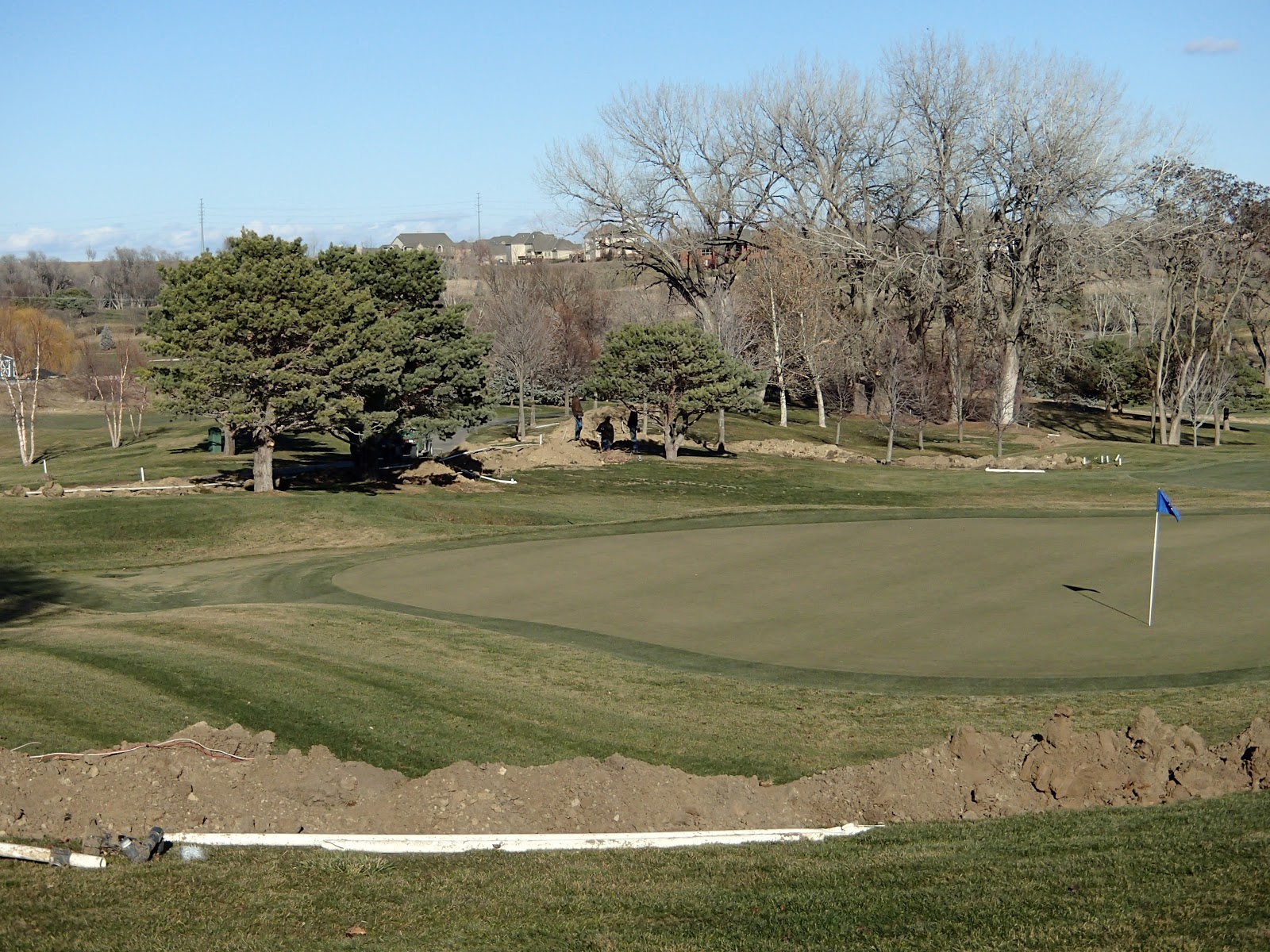
If the drought this summer served any purpose it was to point out the weaknesses in our irrigation system. This fall we selected a handful of these areas to increase our irrigation coverage. Today we started on an area along the cartpath on #2 Black Bird. We hope to increase the turf density by providing this area with more consistent irrigation.
 
The pictures below illustrate the process. This is the first irrigation install project for Tyler and Dusty. For their sake, lets hope it doesn't leak next year.