Showing posts with label UNL Links. Show all posts

Friday, August 30, 2013

Late Summer Heat and Drought Tough on Cool-Season Grasses

Late Summer Heat and Drought Tough on Cool-Season Grasses

In spite of a relatively cool summer, the extended heat and drought over the next week or more may take a toll on cool-season grasses. These grasses are at their weakest point in the year with their lowest energy reserves, and thus their lowest tolerance to stresses like heat, drought, and pests. Minor disease infection with summer patch in Kentucky bluegrass or gray leaf spot in perennial ryegrass, minimal grub feeding in almost all grasses, or traffic in excess or at the hottest part of the day can cause significant damage. The good news is that day lengths are becoming shorter and the heat should not extend for too long into September.

Considerations for turf health in late August heat:

  •  On greens, consider skipping a day of mowing leaning instead to rolling. This maintains maximum photosynthetic area without sacrificing green speed.
  • Hold off on any fertilization until temperatures cool in September.
  • If the roots are very shallow, irrigate frequently and wet the soil only to the depth of rooting. This flies in the face of the “deep and infrequent” irrigation we normally recommend, but we may be soon be into damage control rather than sound turf management
  • Water early in the morning on other turf areas to limit disease pressure as much as possible
  • Syringe Poa annua in the afternoon to cool it slightly and increase its chances for survival
  • Preventative fungicide applications are recommended for high value areas, especially with high Poa annua or perennial ryegrass populations. Brown patch, pythium and gray leaf spot are the primary target disease right now.
  • White grub applications should already be applied but rescue applications with Dylox™ may be needed.
  • Though crabgrass and yellow nutsedge are flourishing, they are at the end of their life cycle and applications are not needed. Almost any herbicide can cause phytotoxicity once temperatures are >85F so avoid applications.
  • Limit topdressing, grooming, verticutting, dethatching or aerification until the weather moderates. If aerification is needed on greens, consider narrow, solid tines.
  • Minimize and restrict traffic where possible and change traffic patterns frequently.
  • If areas were seeded in the last two weeks, fungicides targeted for pythium/rhizoctonia should be applied to help protect the seedlings.


Zac Reicher, Professor of Turfgrass Science, zreicher2@unl.edu

Extension is a Division of the Institute of Agriculture and Natural Resources at the University of Nebraska-Lincoln cooperating with the Counties and the United States Department of Agriculture.
University of Nebraska-Lincoln Extension education programs abide with the nondiscrimination policies of the University of Nebraska-Lincoln and the United States Department of Agriculture.

Monday, August 19, 2013

Yellowing of Kentucky Bluegrass

Yellowing of Kentucky bluegrass

Similar to previous summers with adequate rainfall, Kentucky bluegrass has turned an off-color yellow in the last few weeks (Figs. 1 and 2).

Figure 1. Irrigated Kentucky bluegrass lawn showing severe yellowing on Aug. 6, 2011. Darker green areas are patches of tall fescue or different cultivars of Kentucky bluegrass.

Figure 2. Irrigated Kentucky bluegrass baseball field showing severe yellowing on Aug. 6, 2011. Darker green areas are patches of perennial ryegrass or different cultivars of Kentucky bluegrass. Rectangle of obvious yellow is a sod replaced in the last year.

We are still unsure of what could be causing this. What we do know:

  •  Only the young leaves are yellow (Figs. 3 and 4), so it is probably not related to nitrogen or other nutrients mobile in the plant. However, iron deficiency could explain the symptoms because Fe is relatively immobile in the plant.
  • There are no obvious lesions present so it is not mediated by above-ground diseases.
  • We do not see it in tall fescue, perennial ryegrass, and some cultivars of Kentucky bluegrass (Figs. 1 and 2).
  • We see it when soil temperatures are at their seasonal highs.
  • We see it almost exclusively on irrigated turf and most frequently during wet summers.


Figure 3. Close-up picture showing the lower, older leaves of Kentucky bluegrass farther down in the canopy are retaining their color while the new leaves are chlorotic.


Figure 4. Close-up picture showing the lower, older leaves of Kentucky bluegrass retaining most of their color.
We know from past experience that this a visual effect and long-term health of the plant is not an issue. Therefore, immediate action is probably not needed other than to improve aesthetics. Reducing irrigation in the short should help. Increasing drainage and reducing compaction with more frequent aerification should also help in the long-term. We would not recommend a fungicide, insecticide, or > 0.5 lbs N/1000 sq ft (avoid almost any N in August except on greens or sports turf in use). We often see symptoms similar to this in the spring, but those are usually attributed to denitrification and Fe applications do not help then. However, a low rate of iron may be effective now. Since most the chlorotic leaves are the youngest and higher in the canopy, mowing should remove much of the yellowing.

Zac Reicher, Professor of Turfgrass Science, zreicher2@unl.edu

Extension is a Division of the Institute of Agriculture and Natural Resources at the University of Nebraska-Lincoln cooperating with the Counties and the United States Department of Agriculture.
University of Nebraska-Lincoln Extension education programs abide with the nondiscrimination policies
of the University of Nebraska-Lincoln and the United States Department of Agriculture.

Tuesday, August 6, 2013

Fall Tree Planting


Tree Care After Planting
By Kelly Feehan, UNL Extension Educator
Many trees are planted each spring. Once the right tree is selected for the location and planted at the correct depth, the next steps are correct watering, mulching and staking. Practices to avoid at planting and usually for the first year after planting are fertilizing with nitrogen and pruning.

Watering
Water is critical to root establishment. Even so, more young trees die from too much water than from not enough. This is especially common in denser clay soils or in over-irrigated lawns. Too much water suffocates roots because they require oxygen as much as they need water.

As a rule, maintain a consistently moist soil about eight to 12 inches deep and be sure to moisten the soil outside of the root ball. This will promote root growth outward into surrounding soil. The amount of water and frequency of watering needed to do this depends on the type of nursery stock selected, the soils texture, tree species planted, and weather conditions.

There really is no standard answer such as water once a week with a certain amount of water. This might be too much on a clay soil or for a red oak tree, but too little on a sandy soil or for a river birch.

As a general recommendation, the Nebraska Forest Service recommends watering trees immediately after planting and again the next day. Then water three days later and once again three days after that.
From then on, the key is to monitor the soil around the tree and irrigate as needed. During dry summer spells, balled and burlapped (B&B) trees should be watered about once every seven to ten days if planted in clay soils and about once a week if planted in sandy soils.

Sprinkler systems may provide sufficient water up until summer heat arrives. During the hottest, driest parts of summer, a newly planted tree is likely to require additional water. Container-grown trees will dry out faster than B&B trees. Monitor trees and soil moisture closely.
Mulch
Mulch protects tree roots from extreme temperatures, eliminates weed and grass competition, conserves soil moisture, and keeps lawn equipment away from tree trunks. However, too much mulch can trap moisture at the base of the trunk and negatively impact root growth.
If there is too deep of a mulch layer, roots will grow into the mulch. These roots tend to dry out and die during the heat of summer and are killed by cold winter temperatures. This adds additional stress to young trees trying to recover from transplant shock.

When mulching, use organic mulch like shredded wood. Mulch the tree at least out to the trees drip-line (ends of the branches). Next to the trunk, keep the mulch only one inch thick. Outward, towards the edge of the root ball or at the trees drip-line, mulch can be up to four inches deep but no deeper.

Staking
Staking should be done on trees that are tall and leggy and planted in high wind areas. Keep in mind trees are staked to anchor the root ball, not to eliminate movement of the stem or tree canopy (branches and leaves). The goal is to prevent the root ball from rocking and tearing new roots.
When staking, use materials that will not rub against the trunk and create wounds. Do not stake too high on the tree and only stake a tree for one year after planting. If large trees are moved with a tree spade, they may require staking for two years.

Source: Nebraska Forest Service

Image of improper mulching


Excess mulch application negatively impacts tree health.


Wednesday, June 19, 2013

10 Lawn Irrigation Tips

 
As we approach the hot stretch of summer, water management becomes extremely important. The UNL extension office has put together a list of things to do and look out for while fine tuning your system for the summer months.
Top 10 Lawn & Landscape Irrigation Tips
By John Fech, UNL Extension Horticulture Educator
Image of turf irrigation headThe good news about lawn and landscape irrigation is that you can have your cake and eat it, too! Lawns and landscapes can be designed and maintained to be good looking and water conserving. From the home office in Wahoo, NE, following are 10 useful tips (David Letterman style) to accomplish both objectives.
10. Monitor system output. Measure the amount of water applied in a 15 minute period using collection devices such as tuna or coffee cans. Adjust the run time to deliver the required amount.
9. Know how much water is needed. Kentucky bluegrass lawns, in general, require 1 inch per week in April and May, 1-1/4 inch per week in June, 1-1/2 in July and August, 1 -1/4 in September and 1 inch in October.
8. Measure water penetration. Use a screwdriver or soil probe to measure moisture (rainfall + irrigation water) penetration into the lawn.
7. Water to the bottom of the roots. Use a small shovel to determine how deep the roots are. Actually the soil should be kept moist to about half an inch deeper than the deepest roots to encourage downward growth. Roots are shallow in summer and deeper in spring/fall.
6. When watering on a slope, use “delayed starts.” Run your sprinklers until you notice runoff, then stop. Wait 3 hours, then resume. Aerate to increase infiltration.
5. Water in the early morning (4am to 10am). This allows the grass blades to dry, making them less susceptible to foliar diseases. Watering is more efficient in morning due to less evaporation and wind speed. Change the time that your system runs monthly, or at least seasonally. Contact a lawn sprinkler professional if you need help.
4. Observe your sprinkler system once per month. Look for heads that don’t turn, heads that spray into the street or onto a sidewalk, bent or damaged heads, clogged or worn nozzles or orifices, turf growth around heads that impede water delivery, puddling and runoff.
3. Monitor the spray patterns. Adjust heads as landscape plants grow larger and begin to block the spray pattern. New installations of benches, decks, etc. can also decrease irrigation efficiency.
2. On days when temperatures are above 90°F, run your sprinklers 5 to 10 minutes per zone in the afternoon to cool the turf and reduce stress. This is called “spritzing,” and it reduces the symptoms of summer patch disease.
1. Create water zones by putting plants together that have similar water needs. Each turf species has a different water requirement which is also distinct from ornamentals. Ornamental plants should be grouped into low, moderate and high water users. Each zone of plants should be irrigated according to its needs.

Friday, April 19, 2013

How the Cold Spring Sets Us Back


I am sure you are keenly aware that this spring's weather has been the polar opposite of last year. Cool, wet temperatures have kept our soils saturated and our soil temps well below average. The moisture is a welcome nuisance as it helps restore soil moisture lost during last year's drought, but the low temperatures are not doing us any favors.

We need to seed, and seeding requires a few things to ensure germination: seed-soil contact, moisture, and adequate soil temperatures (50-55 degrees). Without one or more of these requirements, the germination becomes inconsistent at best. Our soil temperatures at 3" were 57.6 degrees as of March 6th last year. We have yet to reach that temperature this year, which puts us 44 days behind last year. Considering the germination period for Ryegrass is five days, we could have had seedlings well on their way to maturity by this time last year.

Golf course superintendents and home owners alike have an uphill battle this year when it comes to repairing turf damage caused by last year's heat and drought. Be patient. The soil will eventually warm and, with any luck, we will have time to get grass out of the ground and mature before the stresses of summer arrive.

Below you will find an article published by the University of Nebraska on this very topic.

When will turfgrass seed germinate this spring (if ever)?
April 17, 2013

Though some of the dormant and winter seedings are germinating in the warmest of areas, spring temperatures are currently averaging two to eight degrees Fahrenheit lower than normal across Nebraska (Figure 1) and the northern Great Plains. Table 1 lists the optimum germination temperatures used in germination testing, but germination will begin at temperatures lower than listed. Temperatures below optimum will slow germination and also development of seedlings. Will seeds eventually germinate and seedlings develop? The answer is a resounding “Yes”, and germination is often seen when soil temperatures near the seed (surface) consistently rise to 50F during the day. Unfortunately, the later these seeds germinate and the slower they mature, the less able the young plants will be to withstand summer stress. Thus irrigation and pesticide use will likely be needed throughout the summer. Another point of caution is herbicide applications may have to be delayed even beyond the label recommendations if the label recommendations are based on days after seeding or potentially days after emergence.


Figure 1. Departure from normal temperature 3/17/2013 to 4/15/2013
(Courtesy of High Plains Regional Climate Center)

Table 1. Optimum temperatures for seed germination.

Turfgrass Species                          Optimum temperatures for seed germination*Creeping bentgrass                         59-86
Annual bluegrass                            68-86
Kentucky bluegrass                        59-86
Tall fescue                                      68-86
Perennial ryegrass                           68-86
Buffalograss                                    68-95

*Temperatures separated by a dash indicate an alternation of temperatures. The first number is for approximately 16 hr and the second for approximately 8 hr, which would translate into cooler temperatures in the 16 hours of evening through morning followed by the 8 hours in the heat of the day. Adapted from Beard’s Turfgrass Science and Culture.

Zac Reicher, Professor, Turfgrass Science, zreicher2@unl.edu

Friday, November 2, 2012

Success of Dormant Seeding

Still dealing with turf damage from the drought? Take a look at the following article. It can help your lawn heal faster next spring.

Improving success of dormant seeding
Oct. 10, 2012

Turf areas are still in sad shape across the region and damage ranges from complete death of turf to a significant loss of turf density on affected areas. We are now out of the window for late summer seeding. Dormant seeing is the next best timing after late summer seeding for establishing cool-season grasses. Following is a summary of points to maximize success of dormant seeding.
  • Timing: Any time after soil temperatures are about 40F in order to guarantee no germination until next spring. Seeding between Thanksgiving and St. Patricks’ Day is a good rule of thumb.
  • Soil preparation: Though simply broadcasting the seed and allowing it to work into the soil naturally through frost-heaving can be effective, it is better to improve seed-soil contact with aerification, powerraking, tilling, power-overseeding, or some other form of cultivation. Wet or frozen soils will likely determine which cultivation is best for each situation, but maximizing seed-soil contact is essential for successful dormant-seeding.
  • Species: Kentucky bluegrass or tall fescue work best, but avoid perennial ryegrass since it may germinate in a mid-winter warm-up only to die in ensuing cold temperatures. Buffalograss can also be dormant-seeded.
  • Seed rate: The typical recommendation is to seed at 10-25% higher rates than normal to account for seed loss via erosion, animal feeding, etc. Seed Kentucky bluegrass at 3.0 lbs/1000 sq ft, tall fescue at 10 lbs/1000 sq ft, and buffalograss at 3.5 lbs/1000 sq ft on bare soils. These rates can be cut by as much as one half if overseeding into existing stands with thin turf.
  • Mulch on bare soils: Mulch is likely not required, but may reduce potential erosion or seed movement. A tackifier will be required on the mulch to minimize wind loss during the winter. Hydroseeding can be used on bare soil if air temperatures are warm enough. Erosion blankets or sod should be used on highly erodible areas.
  • Fertilizer: Starter fertilizer should be applied next spring as the seedlings emerge. Apply 1.0 to 1.50 lbs P2O5/1000 sq ft depending on soil test levels. This same fertilizer and same rate should be applied again four to five weeks after emergence and maybe again at eight to ten weeks after emergence depending on the density of the new stand.
  • Irrigation: Dormant-seeded areas will need irrigation just like any new seeding. Irrigate as often as needed to maintain moisture in the top ¼” of soil, which may mean irrigating once or twice per day. Irrigate less regularly and in larger volumes as the seedlings establish. However, dormant-seeded areas may need irrigation all summer as these relatively young plants will not be mature enough to withstand drought stress.
  • Mowing: Early mowing on any newly-seeded area encourages lateral spread and quick fill-in. On most areas, set the mower 10-20% lower than the regular mowing height for the first 3 to 5 mowings to encourage the most rapid fill-in. Mow as soon as the first few leaves of the seedlings reach the mowing height and mow regularly thereafter (in spite of only apparently affecting a small percentage of the plants) to maximize fill-in.
  • Weed control: Dormant-seedings will be emerging early next spring so most PRE herbicides cannot be used over dormant seeded areas. However, early weed control is critical to minimize weed competition and maximize establishment. In some cases where weed pressure is high, it is justified to apply herbicides early at the risk of turf damage. Even if damage occurs, the remaining turf will likely recover and thrive in the absence of competition. Regardless of the product selected, be sure to refer to the label for specifics. Once the seedlings are mature enough, PRE herbicides including dithiopyr, prodiamine, or pendimethalin can be applied, and this will likely be at the approximate timing of the second application in typical sequential applications of PRE herbicides (mid-June).
    • Mesotrione (Tenacity™) or siduron (Tupersan™) can be used in the seed bed and will likely provide three to four weeks of PRE control of crabgrass.
    • SquareOne™ (quinclorac+carfentrazone) can be applied within 7 DAE of tall fescue or Kentucky bluegrass for POST control of crabgrass and broadleaf weeds.
    • Mesotrione (Tenacity™) can be applied POST to Kentucky bluegrass or tall fescue at 28 days after emergence (DAE) to control crabgrass and some broadleaf weeds.
    • Dithiopyr (Dimension™, Dithiopyr™) can be applied once the root system is well established and after at least two mowings for PRE/POST control of crabgrass.
    • Quinclorac (DRIVE XLR8™, Quinstar™ ,Quinclorac™, and others) can be applied PRE or 28 DAE of Kentucky bluegrass and anytime over tall fescue for POST control of crabgrass and some broadleaf weeds.
    • Carfentrazone (QuickSilver™) can be applied at any time after seeding for POST broadleaf weed control.
Stay tuned for more information on seeding and you will hear much more about repairing drought-damaged turf at the Nebraska Turf Conference in Lavista on Jan. 8-10. Registration and information will be available at online at www.nebraskaturfgrass.com shortly.

Zac Reicher, Professor, Turfgrass Science, zreicher2@unl.edu

Tuesday, October 23, 2012

Autumn Weed Control

For those of you who take care of your own lawns, the following article could help you prepare your lawn for the winter. The fall is the best time to take care of weeds and give yourself a clean yard entering next year's growing season.

Professional Use: How late is too late to control dandelions and other weeds this fall?Oct 10, 2012
We are now in the prime season for broadleaf weed control starting about September 15, but there is plenty of time in the fall for good, if not even improved, control over earlier applications. Nebraska research in agricultural fields reported in 2003 showed 2,4-D and/or dicamba were more effective in controlling dandelions and Canada thistle when applied 1 to 10 days after the first fall frost than when applied 5 to 11 days before the frost (Wilson and Michaels, 2003). Earlier work by Bruce Branham at Michigan State showed that even though early September applications were effective in controlling broadleaves yet that same fall, September applications were less effective long-term than applications made in October and November (Figure 1). More recent work on ground ivy at Purdue shows that herbicides like triclopyr (Turflon) that are very effective on ground ivy, retain their effectiveness when applied regardless of the first frost and as late as early- to mid-November(Figure 2) (Reicher and Weisenberger, 2007). However, herbicides with lower activity on ground ivy were most effective from Oct 1 through Nov 1, and efficacy decreased outside of this window. This study showed that broadleaf applications should be effective when made into the first week or two of November, but control may not be seen until spring. However, herbicides that contain carfentrazone (FMC’s Quicksilver, PBI Gordons’ Powerzone and Speedzone) will still give a response in 7 to 14 days even when applied in late October or early November. More recent studies at
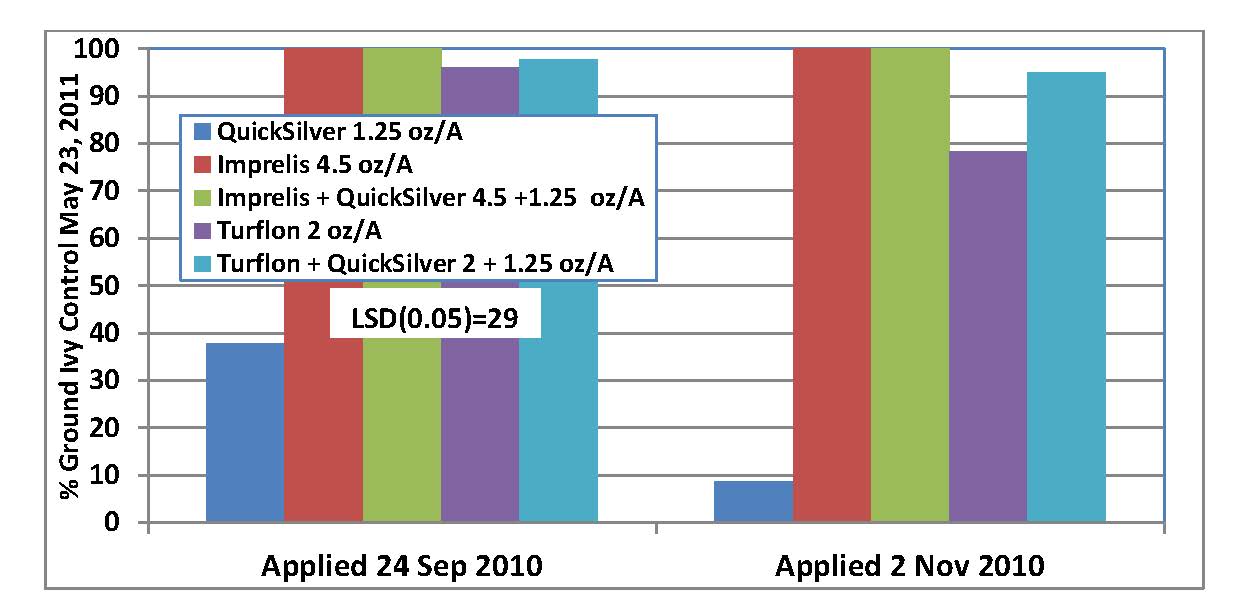
Purdue were applied in Fall of 2007 used the two most effective herbicides on ground ivy from previous studies, triclopyr (Turflon) and fluroxypyr (Spotlight), and applied them with and without carfentrazone (QuickSilver) on Sept. 15, Oct. 15, and Nov. 15. QuickSilver had similar effects on both herbicides, dramatically improving short-term control from November applications (Figure 3). Though one might suspect that QuickSilver would decrease longterm control because the quick burndown could limit herbicide translocation, QuickSilver did not decrease longterm control from these herbicides as rated the following May (Figure 4). Similar to our previous work, Turflon applied as late as Nov 15 provided over 90% control by the following May of the very difficult-to-control ground ivy .We repeated this research at UNL in fall of 2010 with the then popular herbicide Imprelis, which is now off the market. The same trends occurred, even on the extremely difficult-to-control Nebraska ground ivy (Kohler et al., 2004) (Figure 5 and 6). The take home message is that broadleaf herbicides can be very effective when applied well into the fall. If quick knockdown is required for immediate customer satisfaction in applic ations later in the fall, using products or tank mixes that contain carfentrazone will give a rapid burndown while not decreasing longterm control.

Zac Reicher, Professor, Turfgrass Science, zreicher2@unl.edu

Figure 1. Effect of fall timing of broadleaf herbicides on control rated in Nov after application and again the following May. Note how Sep 24 applications were most effective when rated the following November, but later applications were more effective when rated the following spring (Michigan State 1986).


Figure 2. Three year averages of effects of herbicides applied in fall on ground ivy control when measured in May the
following year. Turflon (triclopyr) or Vista (or Spotlight, common name fluroxpyr) retained effectiveness regardless of
application date, whereas the efficacy of the 2,4-D-based carfentrazone suffered outside of Oct 1 through Nov 1
window. (Purdue 2007).


Figure 3. Short-term control of ground ivy rated in December from Spotlight or Turflon with and without QuickSilver.
Turflon and Spotlight applied in Sept or October provided adequate control by December. Combining QuickSilver with
both products dramatically improved control when applications were made in November (Purdue 2008).

Figure 4. Long-term control of ground ivy rated in May after fall applications of Spotlight or Turflon with and without
QuickSilver. Turflon and Spotlight applied in Sept or October provided excellent long-term control. Triclopyr applied in November provided over 90% control by May. Combining QuickSilver with both products had no statistically
significant effects either positive or negative on long-term control (Purdue 2008).

Figure 5. Short-term control of ground ivy rated on Nov 16 after fall applications of Imprelis or Turflon with and
without QuickSilver. Turflon and Imprelis applied in September, but poor short-term control when applied on 2 Nov.
Combining QuickSilver with either product dramatically improved speed of control when applied in November (Univ of
Nebraska-Lincoln, 2011).


Figure 6. Long-term control of ground ivy rated in May after fall applications of Imprelis or Turflon with and without
QuickSilver. Turflon or Imprelis applied in Sept or November provided excellent long-term control. Combining
QuickSilver with both products had no statistically significant effects on long-term control November (Univ of
Nebraska-Lincoln, 2011).

References:
1. Kohler, E. A., C. S. Throssell and Z. J. Reicher. 2004. Ground ivy (Glechoma hederacea) populations respond differently to
2,4-D or triclopyr. Weed Technology 18(3):566-574.
2. Reicher, Z. J., and Weisenberger, D. V. 2007. Herbicide selection and application timing in the fall affects control of ground
ivy. Online. Applied Turfgrass Science doi:10.1094/ATS-2007-0831-01-RS.
3. Wilson, R. G., and Michiels, A. 2003. Fall herbicide treatments affect carbohydrate content in roots of Canada thistle
(Cirsium arvense) and dandelion (Taraxacum officinale). Weed Sci. 51:299-304.

Tuesday, October 16, 2012

October Mowing


The following article was published by the University of Nebraska and provides tips about maintaining your lawn this fall and preparing it for winter. I thought it could help you all as our growing season comes to an end.

Many people ask how long to continue mowing into the fall. The answer is to keep mowing as long as the grass continues to grow, which is normally into late October or early November. Frequency of mowing can decrease, but continue to mow regularly into the fall. Avoid the urge to set the mower down and scalp your lawn for the final mowing. In years past, publications have recommended mowing low late in the fall. About the only advantage to this is that the tree leaves will blow from your lawn into the neighbor's lawn. Agronomically, mowing your lawn low in the last mowing should be avoided because photosynthesis is occurring deep into the fall, well beyond your last mowing. The higher the photosynthesis, the more energy a grass plant will store for winter and next spring, and the healthier the will be next year. Mowing off too much leaf area reduces photosynthetic capacity of a plant, reducing energy storage, and decreasing turf performance next summer. Regular mowing into the fall is also helpful to mulch tree leaves into the lawn, which research has shown to be beneficial
(http://turf.unl.edu/pdfctarticles/Octmulchtreeleaves.pdf). Continue mowing at your regular height until the grass stops growing in the late fall, since unmowed tall grass can encourage snow mold in rare years.

Zac Reicher, Professor, Turfgrass Science, zreicher2@unl.edu

Sunday, July 22, 2012

Heat Taking a Toll on Golf Turf

Heat taking a toll on golf turf
July 21, 2012


Though golf turf is still performing fairly well in spite of heat and drought, cool-season turfgrasses simply cannot survive the extended heat. As one local superintendent quoted, ”Temperatures like this is why they grow zoysia just an hour or two south of here.” The reason cool-season grasses cannot survive extended heat is physiological. Cool-season grasses reach maximum photosynthesis near 75F air temperature and drop off sharply at higher temperatures. Conversely, respiration or energy consumption of cool season grasses increases with rising temperatures. At elevated temperatures, cool-season plants are in energy deficit where they are using more energy in respiration to stay alive than they are producing in photosynthesis. All grasses can survive this energy imbalance for a given period by using carbohydrate storage accumulated earlier in the year when photosynthesis
was higher than respiration.

How long they will survive this energy imbalance is complex and depends on many issues such as duration of elevated temperatures, frequency of cool nights, species, cultivar, previous maintenance, mowing height, traffic, etc. Often when these plants are weakened, it takes one small stress to put the plant over the edge or the proverbial straw that breaks the camel’s back. Small stresses include slight drought stress, minor disease, traffic, a light dusting of topdressing, insect feeding, etc. The bright spot this year for golf courses is the drought and relatively low humidity has limited most of the damaging diseases and allowed superintendents to manage irrigation to keep turf dry. Annual bluegrass is the weakest turf species during the summer, and is always the first to die. Annual bluegrass on golf courses is currently yellowing and I’d expect it to start to thin and die in the very near future given the current forecast of the next four days above 100F in eastern NE. Fungicides and previous applications of trinexapac may help delay the decline, but it is difficult to avoid the inevitable thinning of annual bluegrass in a year like this. Perennial ryegrass on tees and fairways can also be one of the weaker species, and weakening from the heat is often exaggerated by pythium, brown patch, or potentially gray leaf spot. Fungicides may be effective at preventing widespread damage on perennial ryegrass.

As mentioned in a previous Turf iNfo (http://turf.unl.edu/pdfctarticles/juneheat.pdf), following are practices to minimize stress on golf turf:
  • Continue to manage irrigation to keep turf as dry as possible while staying away from drought stress. This will maximize soil oxygen to maintain roots, while also providing ample soil water so the plant can cool itself.
  • Syringe annual bluegrass in middle of the day. This works on turf with compromised root systems (annual bluegrass, seedlings of other grasses, or turf affected by white grubs or summer patch.
  • Continue preventative fungicides to minimize additional stress.
  • Roll greens whenever practical to maintain speed instead of mowing. Continue mowing as needed, but be sure turf is well-watered to insure no extra damage.
  • The drought will concentrate egg-laying of masked chafers and/or Japanese beetles to irrigated turf areas.
  • Watch for breaks in your insecticide applications.
  • Switch to solid rollers instead of grooved rollers on all reel-type mowers.
  • Aerify as needed with solid narrow tines to increase water and air movement. Insure the areas are wellwatered prior and consider this during cloud cover or in the cooler parts of the day.
Zac Reicher, Professor of Turfgrass Science, zreicher2@unl.edu, turf.unl.edu

Kentucky Bluegrass

How long will Kentucky bluegrass or tall fescue survive when dormant?
July 21, 2012

The most common question we are answering now is about how long lawns can go without watering and still survive. Either because of drought or perhaps to conserve water, cool-season grasses can be allowed to go dormant in extended droughts. Once Kentucky bluegrass (KBG) goes fully dormant from drought, the rule of thumb is to water ¼” of water about every four weeks to keep the crowns hydrated and to help insure survival. Upon return of cooler temperatures and increased rain/irrigation, KBG should regreen with only minimal thinning assuming no traffic during dormancy. Traffic during dormancy may damage crowns and increase thinning upon recovery. Excess heat that we are experiencing should likely not significantly affect KBG during dormancy.

Turf-type tall fescue (TTF) will go dormant much later than KBG under similar conditions. This is because TTF is deeper-rooted than KBG and accesses water deeper in the profile. Tall fescue actually uses significantly more water than KBG. Tall fescue has poorer drought survival than KBG and thus we usually recommend to irrigate often enough to prevent tall fescue from going into complete dormancy. Given the extremely dry conditions, it’s likely impossible to prevent dormancy in TTF. Therefore, we recommend applying ¼” of water every two to three weeks trying to limit damage during dormancy. We’re still unsure how well TTF will survive in summers like this, but the
expanding acreage of TTF use over the last few years will give us a better idea after this summer.

Regardless of the species, keep all traffic (including mowing) off dormant areas. Even foot traffic will potentially damage the crowns and decrease survival.

Zac Reicher, Professor of Turfgrass Science, zreicher2@unl.edu, turf.unl.edu