Friday, November 9, 2012

Late Season Fertility

The videos below show my assistants Jeff and Nate wrapping up our late season fertilizer application.

If you are out playing this weekend, you may notice the course is wetter than normal. This is because we have been watering this fertilizer in as we apply it. The fertilizer we used has both a polymer and sulfur coat protecting the nitrogen. Water acts as the catalyst for the release of the nitrogen. This coating gives us a little more control over the nitrogen release and will hopefully protect some of that nitrogen over the winter, leaving enough to feed the turf when the soil warms up in the spring. Hopefully, it will also be around to help stimulate any new spring seedlings that emerge as a result of our dormant seeding.

The hot dry summer took its toll on our non-irrigated areas so we have ramped up our late season fertility program to include these areas as well. In total we have fertilized 180 acres of maintained turf over a two-week period.  


Thursday, November 8, 2012

Drain Basin Work

 
Sophie had to come out and inspect the drain basin construction. She agrees that is some good looking work.


Friday, November 2, 2012

Success of Dormant Seeding

Still dealing with turf damage from the drought? Take a look at the following article. It can help your lawn heal faster next spring.

Improving success of dormant seeding
Oct. 10, 2012

Turf areas are still in sad shape across the region and damage ranges from complete death of turf to a significant loss of turf density on affected areas. We are now out of the window for late summer seeding. Dormant seeing is the next best timing after late summer seeding for establishing cool-season grasses. Following is a summary of points to maximize success of dormant seeding.
  • Timing: Any time after soil temperatures are about 40F in order to guarantee no germination until next spring. Seeding between Thanksgiving and St. Patricks’ Day is a good rule of thumb.
  • Soil preparation: Though simply broadcasting the seed and allowing it to work into the soil naturally through frost-heaving can be effective, it is better to improve seed-soil contact with aerification, powerraking, tilling, power-overseeding, or some other form of cultivation. Wet or frozen soils will likely determine which cultivation is best for each situation, but maximizing seed-soil contact is essential for successful dormant-seeding.
  • Species: Kentucky bluegrass or tall fescue work best, but avoid perennial ryegrass since it may germinate in a mid-winter warm-up only to die in ensuing cold temperatures. Buffalograss can also be dormant-seeded.
  • Seed rate: The typical recommendation is to seed at 10-25% higher rates than normal to account for seed loss via erosion, animal feeding, etc. Seed Kentucky bluegrass at 3.0 lbs/1000 sq ft, tall fescue at 10 lbs/1000 sq ft, and buffalograss at 3.5 lbs/1000 sq ft on bare soils. These rates can be cut by as much as one half if overseeding into existing stands with thin turf.
  • Mulch on bare soils: Mulch is likely not required, but may reduce potential erosion or seed movement. A tackifier will be required on the mulch to minimize wind loss during the winter. Hydroseeding can be used on bare soil if air temperatures are warm enough. Erosion blankets or sod should be used on highly erodible areas.
  • Fertilizer: Starter fertilizer should be applied next spring as the seedlings emerge. Apply 1.0 to 1.50 lbs P2O5/1000 sq ft depending on soil test levels. This same fertilizer and same rate should be applied again four to five weeks after emergence and maybe again at eight to ten weeks after emergence depending on the density of the new stand.
  • Irrigation: Dormant-seeded areas will need irrigation just like any new seeding. Irrigate as often as needed to maintain moisture in the top ¼” of soil, which may mean irrigating once or twice per day. Irrigate less regularly and in larger volumes as the seedlings establish. However, dormant-seeded areas may need irrigation all summer as these relatively young plants will not be mature enough to withstand drought stress.
  • Mowing: Early mowing on any newly-seeded area encourages lateral spread and quick fill-in. On most areas, set the mower 10-20% lower than the regular mowing height for the first 3 to 5 mowings to encourage the most rapid fill-in. Mow as soon as the first few leaves of the seedlings reach the mowing height and mow regularly thereafter (in spite of only apparently affecting a small percentage of the plants) to maximize fill-in.
  • Weed control: Dormant-seedings will be emerging early next spring so most PRE herbicides cannot be used over dormant seeded areas. However, early weed control is critical to minimize weed competition and maximize establishment. In some cases where weed pressure is high, it is justified to apply herbicides early at the risk of turf damage. Even if damage occurs, the remaining turf will likely recover and thrive in the absence of competition. Regardless of the product selected, be sure to refer to the label for specifics. Once the seedlings are mature enough, PRE herbicides including dithiopyr, prodiamine, or pendimethalin can be applied, and this will likely be at the approximate timing of the second application in typical sequential applications of PRE herbicides (mid-June).
    • Mesotrione (Tenacity™) or siduron (Tupersan™) can be used in the seed bed and will likely provide three to four weeks of PRE control of crabgrass.
    • SquareOne™ (quinclorac+carfentrazone) can be applied within 7 DAE of tall fescue or Kentucky bluegrass for POST control of crabgrass and broadleaf weeds.
    • Mesotrione (Tenacity™) can be applied POST to Kentucky bluegrass or tall fescue at 28 days after emergence (DAE) to control crabgrass and some broadleaf weeds.
    • Dithiopyr (Dimension™, Dithiopyr™) can be applied once the root system is well established and after at least two mowings for PRE/POST control of crabgrass.
    • Quinclorac (DRIVE XLR8™, Quinstar™ ,Quinclorac™, and others) can be applied PRE or 28 DAE of Kentucky bluegrass and anytime over tall fescue for POST control of crabgrass and some broadleaf weeds.
    • Carfentrazone (QuickSilver™) can be applied at any time after seeding for POST broadleaf weed control.
Stay tuned for more information on seeding and you will hear much more about repairing drought-damaged turf at the Nebraska Turf Conference in Lavista on Jan. 8-10. Registration and information will be available at online at www.nebraskaturfgrass.com shortly.

Zac Reicher, Professor, Turfgrass Science, zreicher2@unl.edu

Tuesday, October 30, 2012

Edging Bunkers

 
Over the last few weeks, we have been working on edging the bunkers on Black Bird. We have the edges cut on all of the bunkers except the right fairway bunker on #3. We want to make some adjustments to the size and shape of this bunker over the winter months so the edge will be addressed at that time. Next, we will be moving to Red Feather and will most likely get to Gray Hawk next spring.

Once all the edges are cut we will go back and repair the areas where the bunker liner has moved up through the sand. It is also at this time that we will replenish any sand that has been removed through the edging process. Below are a few pictures of the process.


Tuesday, October 23, 2012

Autumn Weed Control

For those of you who take care of your own lawns, the following article could help you prepare your lawn for the winter. The fall is the best time to take care of weeds and give yourself a clean yard entering next year's growing season.

Professional Use: How late is too late to control dandelions and other weeds this fall?Oct 10, 2012
We are now in the prime season for broadleaf weed control starting about September 15, but there is plenty of time in the fall for good, if not even improved, control over earlier applications. Nebraska research in agricultural fields reported in 2003 showed 2,4-D and/or dicamba were more effective in controlling dandelions and Canada thistle when applied 1 to 10 days after the first fall frost than when applied 5 to 11 days before the frost (Wilson and Michaels, 2003). Earlier work by Bruce Branham at Michigan State showed that even though early September applications were effective in controlling broadleaves yet that same fall, September applications were less effective long-term than applications made in October and November (Figure 1). More recent work on ground ivy at Purdue shows that herbicides like triclopyr (Turflon) that are very effective on ground ivy, retain their effectiveness when applied regardless of the first frost and as late as early- to mid-November(Figure 2) (Reicher and Weisenberger, 2007). However, herbicides with lower activity on ground ivy were most effective from Oct 1 through Nov 1, and efficacy decreased outside of this window. This study showed that broadleaf applications should be effective when made into the first week or two of November, but control may not be seen until spring. However, herbicides that contain carfentrazone (FMC’s Quicksilver, PBI Gordons’ Powerzone and Speedzone) will still give a response in 7 to 14 days even when applied in late October or early November. More recent studies at
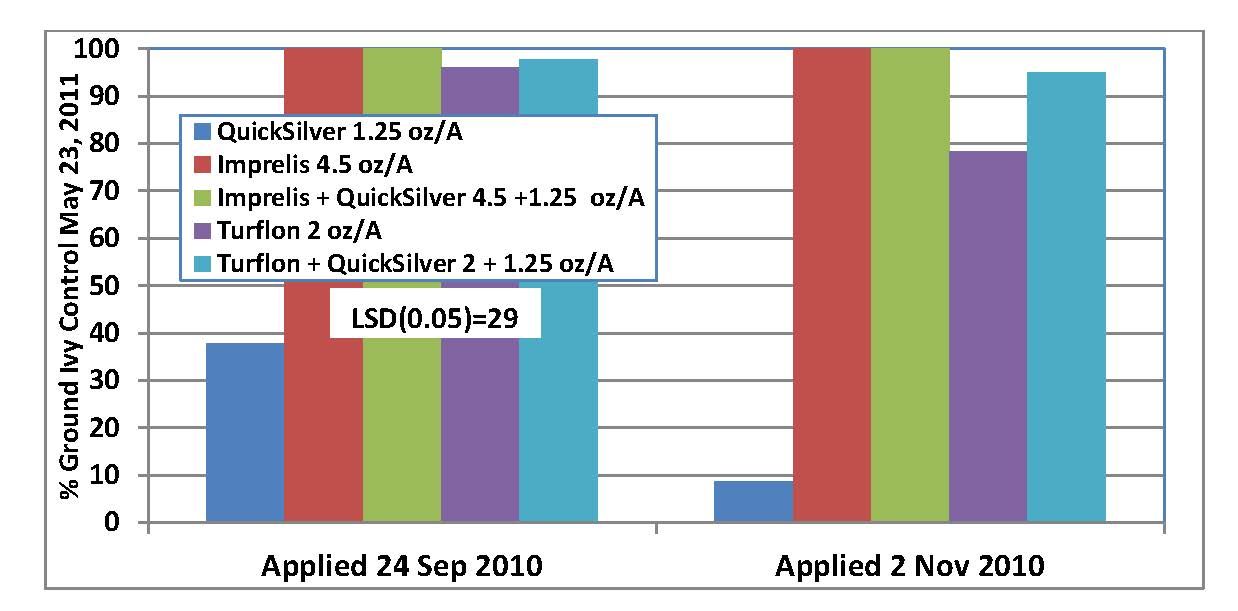
Purdue were applied in Fall of 2007 used the two most effective herbicides on ground ivy from previous studies, triclopyr (Turflon) and fluroxypyr (Spotlight), and applied them with and without carfentrazone (QuickSilver) on Sept. 15, Oct. 15, and Nov. 15. QuickSilver had similar effects on both herbicides, dramatically improving short-term control from November applications (Figure 3). Though one might suspect that QuickSilver would decrease longterm control because the quick burndown could limit herbicide translocation, QuickSilver did not decrease longterm control from these herbicides as rated the following May (Figure 4). Similar to our previous work, Turflon applied as late as Nov 15 provided over 90% control by the following May of the very difficult-to-control ground ivy .We repeated this research at UNL in fall of 2010 with the then popular herbicide Imprelis, which is now off the market. The same trends occurred, even on the extremely difficult-to-control Nebraska ground ivy (Kohler et al., 2004) (Figure 5 and 6). The take home message is that broadleaf herbicides can be very effective when applied well into the fall. If quick knockdown is required for immediate customer satisfaction in applic ations later in the fall, using products or tank mixes that contain carfentrazone will give a rapid burndown while not decreasing longterm control.

Zac Reicher, Professor, Turfgrass Science, zreicher2@unl.edu

Figure 1. Effect of fall timing of broadleaf herbicides on control rated in Nov after application and again the following May. Note how Sep 24 applications were most effective when rated the following November, but later applications were more effective when rated the following spring (Michigan State 1986).


Figure 2. Three year averages of effects of herbicides applied in fall on ground ivy control when measured in May the
following year. Turflon (triclopyr) or Vista (or Spotlight, common name fluroxpyr) retained effectiveness regardless of
application date, whereas the efficacy of the 2,4-D-based carfentrazone suffered outside of Oct 1 through Nov 1
window. (Purdue 2007).


Figure 3. Short-term control of ground ivy rated in December from Spotlight or Turflon with and without QuickSilver.
Turflon and Spotlight applied in Sept or October provided adequate control by December. Combining QuickSilver with
both products dramatically improved control when applications were made in November (Purdue 2008).

Figure 4. Long-term control of ground ivy rated in May after fall applications of Spotlight or Turflon with and without
QuickSilver. Turflon and Spotlight applied in Sept or October provided excellent long-term control. Triclopyr applied in November provided over 90% control by May. Combining QuickSilver with both products had no statistically
significant effects either positive or negative on long-term control (Purdue 2008).

Figure 5. Short-term control of ground ivy rated on Nov 16 after fall applications of Imprelis or Turflon with and
without QuickSilver. Turflon and Imprelis applied in September, but poor short-term control when applied on 2 Nov.
Combining QuickSilver with either product dramatically improved speed of control when applied in November (Univ of
Nebraska-Lincoln, 2011).


Figure 6. Long-term control of ground ivy rated in May after fall applications of Imprelis or Turflon with and without
QuickSilver. Turflon or Imprelis applied in Sept or November provided excellent long-term control. Combining
QuickSilver with both products had no statistically significant effects on long-term control November (Univ of
Nebraska-Lincoln, 2011).

References:
1. Kohler, E. A., C. S. Throssell and Z. J. Reicher. 2004. Ground ivy (Glechoma hederacea) populations respond differently to
2,4-D or triclopyr. Weed Technology 18(3):566-574.
2. Reicher, Z. J., and Weisenberger, D. V. 2007. Herbicide selection and application timing in the fall affects control of ground
ivy. Online. Applied Turfgrass Science doi:10.1094/ATS-2007-0831-01-RS.
3. Wilson, R. G., and Michiels, A. 2003. Fall herbicide treatments affect carbohydrate content in roots of Canada thistle
(Cirsium arvense) and dandelion (Taraxacum officinale). Weed Sci. 51:299-304.

Tuesday, October 16, 2012

October Mowing


The following article was published by the University of Nebraska and provides tips about maintaining your lawn this fall and preparing it for winter. I thought it could help you all as our growing season comes to an end.

Many people ask how long to continue mowing into the fall. The answer is to keep mowing as long as the grass continues to grow, which is normally into late October or early November. Frequency of mowing can decrease, but continue to mow regularly into the fall. Avoid the urge to set the mower down and scalp your lawn for the final mowing. In years past, publications have recommended mowing low late in the fall. About the only advantage to this is that the tree leaves will blow from your lawn into the neighbor's lawn. Agronomically, mowing your lawn low in the last mowing should be avoided because photosynthesis is occurring deep into the fall, well beyond your last mowing. The higher the photosynthesis, the more energy a grass plant will store for winter and next spring, and the healthier the will be next year. Mowing off too much leaf area reduces photosynthetic capacity of a plant, reducing energy storage, and decreasing turf performance next summer. Regular mowing into the fall is also helpful to mulch tree leaves into the lawn, which research has shown to be beneficial
(http://turf.unl.edu/pdfctarticles/Octmulchtreeleaves.pdf). Continue mowing at your regular height until the grass stops growing in the late fall, since unmowed tall grass can encourage snow mold in rare years.

Zac Reicher, Professor, Turfgrass Science, zreicher2@unl.edu

Monday, October 1, 2012

Gray Hawk Construction Update


 The construction on Gray Hawk will wrap up over the next couple of days. All that remains are "punch list" items and the leveling of a few irrigation heads. All and all, the project went very smoothly.

The dry soils made shaping, grading, and backfilling a bit more difficult, and I will be interested to see if we have more settling this year than in years past.  

Green, tee, and fairway germination rates have been the highest and most consistent we have seen with any of the renovations. We will mow fairways for the second time tomorrow at a height of 1". The more we can mow these fairways, the faster they will reach their desired density. We are pushing them a little more this year by using biweekly foliar Urea applications. The low overnight temperatures expected at the end of this week could slow their progress, but we will have to wait and see.

I couldn't be more pleased with the way greens are growing in. We made a couple of minor changes to the way we prepared the greens to receive seed and they have made all the difference. Greens have been mowed six times and are down to a height of .190". We will start mowing them daily until growth slows and hope to get them down to a height of .150" by the end of the season. Their density gets better by the day. Topdressing and foliar fertilizer applications will be the key to getting the greens as mature as we can before winter. Rolling will also become important as we try and smooth out all the humps and bumps created during the regrassing process.

As the grow in continues, my focus will shift toward tree replacement. With all renovations, there has to be some tree removal and it is important to replace these.  Now that the holes are taking shape and we can envision how they will be played, we can start to add trees. This is one of my favorite aspects of the process. The correct placement of a tree can have a long lasting impact on how the hole looks and plays.


#5 Gray Hawk from 200 yards

#6 Gray Hawk from 300 yards
#7 Gray Hawk from 200 yards
#2 Gray Hawk green 30 days after seeding